
W.L. Weller
Buffalo Trace
W.L. Weller is Buffalo Trace Distillery's flagship wheated bourbon brand — a nine-expression lineup running from the entry-level Special Reserve to the $7,500 Weller Millennium and the annual barrel-proof William Larue Weller release from the Buffalo Trace Antique Collection. Every Weller expression is built on the wheated mash bill style William Larue Weller championed in his 19th-century Louisville whiskey-merchant business — corn, soft red winter wheat (in place of the rye most bourbons use), and malted barley — the same recipe family that defines Pappy Van Winkle, the historic Stitzel-Weller bourbon program, and the modern wheated bourbon category broadly. The brand is distilled, aged, and bottled at Buffalo Trace Distillery (DSP-KY-113) in Frankfort, Kentucky under Master Distiller Harlen Wheatley. Sazerac Company acquired the George T. Stagg Distillery in 1992 (renaming it Buffalo Trace Distillery in 1999), and separately acquired the W.L. Weller bourbon brand from Diageo/United Distillers in 1999.
The Weller line spans nine distinct expressions: W.L. Weller Special Reserve (90 proof, no age statement, the entry expression), W.L. Weller 12 Year (90 proof, 12-year age statement, the only age-stated expression in the core lineup), W.L. Weller Antique 107 (107 proof, no age statement), W.L. Weller Single Barrel (97 proof, hand-selected single barrels launched June 2020), W.L. Weller C.Y.P.B. or "Craft Your Perfect Bourbon" (95 proof, 8-year wheated bourbon launched 2018 after collecting consumer recipe preferences, annual May release), W.L. Weller Full Proof (114 proof, bottled at the same proof the bourbon entered the barrel), William Larue Weller (the annual barrel-proof BTAC release, proof varies year to year), Daniel Weller (the experimental line launched 2023 honoring William Larue's grandfather Daniel Weller, exploring different wheat strains starting with Emmer wheat at 94 proof, nearly 12 years old), and Weller Millennium (launched June 2024 at $7,500 MSRP, a 99-proof blend of vintage wheated bourbon and wheat whiskey from barrels 18 to 24 years old).
The W.L. Weller heritage is one of American whiskey's most layered backstories. William Larue Weller, born in 1825, founded W.L. Weller & Brother in 1849 in Louisville with his younger brother Charles, building a whiskey wholesale and rectifying business (Weller himself did not distill — he purchased aged whiskey barrels from distilleries, including the Stitzel Brothers Distillery, then blended, bottled, and sold them). Weller championed the use of wheat in place of rye as bourbon's secondary grain in the whiskey he sourced and sold — a recipe choice that ultimately defined the modern wheated bourbon category and that Sazerac markets as making Weller "The Original Wheated Bourbon." Weller's other lasting contribution was hiring a young salesman named Julian "Pappy" Van Winkle Sr. in 1893; Pappy and his partner Alex T. Farnsley would eventually buy W.L. Weller & Sons from William's sons around 1908-1909, going on to acquire the A. Ph. Stitzel Distillery in 1910 and open the famed Stitzel-Weller Distillery on Derby Day 1935. The Weller brand stayed with the Stitzel-Weller program through that distillery's 1992 closure, and Sazerac acquired the Weller brand in 1999 from Diageo/United Distillers. Today the wheated bourbon recipe family William Larue Weller championed in the 1840s lives on in every bottle of Weller, every bottle of Pappy Van Winkle, and every William Larue Weller BTAC release that crosses Cana Wine Co.'s counter.

W.L.Weller
-
W. L. Weller Old Weller Antique 107 Kentucky Straight Wheated Bourbon Whiskey 750ml
Original price $159.99Original price $159.99 - Original price $159.99Original price $159.99Current price $139.99$139.99 - $139.99Current price $139.99Old Weller Antique 107 is a 107 Proof (53.5% ABV) wheated bourbon produced at the Buffalo Trace Distillery in Frankfort, KY. This expression is com...
View full detailsOriginal price $159.99Original price $159.99 - Original price $159.99Original price $159.99Current price $139.99$139.99 - $139.99Current price $139.99Save $20.00 -


W. L. Weller Full Proof Kentucky Straight Wheated Bourbon Whiskey 750ml
Original price $199.99 - Original price $199.99Original price$199.99$199.99 - $199.99Current price $199.99W. L. Weller Full Proof is a 114 Proof (57% ABV) premium wheated bourbon produced at the Buffalo Trace Distillery in Frankfort, KY. This high-proof...
View full detailsOriginal price $199.99 - Original price $199.99Original price$199.99$199.99 - $199.99Current price $199.99 -
W. L. Weller Special Reserve Kentucky Straight Wheated Bourbon Whiskey 750ml
Original price $69.99Original price $69.99 - Original price $69.99Original price $69.99Current price $59.99$59.99 - $59.99Current price $59.99W. L. Weller Special Reserve is a 90 Proof (45% ABV) highly sought-after premium wheated bourbon produced at the Buffalo Trace Distillery in Frankf...
View full detailsOriginal price $69.99Original price $69.99 - Original price $69.99Original price $69.99Current price $59.99$59.99 - $59.99Current price $59.99Save $10.00 -
W. L. Weller 12 Year Old Kentucky Straight Wheated Bourbon Whiskey 700ml
Original price $184.99Original price $184.99 - Original price $184.99Original price $184.99Current price $179.99$179.99 - $179.99Current price $179.99Discover the essence of refinement with W. L. Weller 12 Year Old Kentucky Straight Wheated Bourbon Whiskey, a true gem in the world of bourbon. Age...
View full detailsOriginal price $184.99Original price $184.99 - Original price $184.99Original price $184.99Current price $179.99$179.99 - $179.99Current price $179.99Sold out -
W. L. Weller 12 Year Old Kentucky Straight Wheated Bourbon Whiskey 750ml
Original price $249.99Original price $249.99 - Original price $249.99Original price $249.99Current price $219.99$219.99 - $219.99Current price $219.99W. L. Weller 12 Year Old is a 90 Proof (45% ABV) small-batch wheated bourbon produced at the Buffalo Trace Distillery in Frankfort, KY. This expres...
View full detailsOriginal price $249.99Original price $249.99 - Original price $249.99Original price $249.99Current price $219.99$219.99 - $219.99Current price $219.99Save $30.00 -


W. L. Weller Single Barrel Straight Wheated Bourbon Whiskey 750ml
Original price $299.99 - Original price $299.99Original price$299.99$299.99 - $299.99Current price $299.99W. L. Weller Single Barrel is a 97 Proof (48.5% ABV) rare and highly allocated premium wheated bourbon produced at the Buffalo Trace Distillery in ...
View full detailsOriginal price $299.99 - Original price $299.99Original price$299.99$299.99 - $299.99Current price $299.99 -


W. L. Weller C.Y.P.B. Craft Your Perfect Bourbon The Original Wheated Kentucky Straight Bourbon Whiskey 750ml
Original price $449.99 - Original price $449.99Original price$449.99$449.99 - $449.99Current price $449.99W. L. Weller C.Y.P.B. (Craft Your Perfect Bourbon) is a 95 Proof (47.5% ABV) premium wheated bourbon produced at the Buffalo Trace Distillery in Fr...
View full detailsOriginal price $449.99 - Original price $449.99Original price$449.99$449.99 - $449.99Current price $449.99 -
W. L. Weller Special Reserve Kentucky Straight Wheated Bourbon Whiskey 1.75Lt
Original price $129.99Original price $129.99 - Original price $129.99Original price $129.99Current price $99.99$99.99 - $99.99Current price $99.99W. L. Weller Special Reserve is a 90 Proof (45.0% ABV) rare and highly sought-after premium wheated bourbon produced at the Buffalo Trace Distiller...
View full detailsOriginal price $129.99Original price $129.99 - Original price $129.99Original price $129.99Current price $99.99$99.99 - $99.99Current price $99.99Save $30.00 -


W. L. Weller Special Reserve Kentucky Straight Wheated Bourbon Whiskey 1Lt
Original price $69.99 - Original price $69.99Original price$69.99$69.99 - $69.99Current price $69.99Discover the elegance of W. L. Weller Special Reserve Kentucky Straight Wheated Bourbon Whiskey, available at Cana Wine Co. Crafted with a wheated ...
View full detailsOriginal price $69.99 - Original price $69.99Original price$69.99$69.99 - $69.99Current price $69.99 -
W. L. Weller Collector's Pick Bourbon Whiskey Bundle 750ml 5-Pack
Original price $1,199.99Original price $1,199.99 - Original price $1,199.99Original price $1,199.99Current price $1,149.99$1,149.99 - $1,149.99Current price $1,149.99W. L. Weller Collector's Pick Bourbon Whiskey Bundle 5-Pack: W.L. Weller C.Y.P.B Experience the pinnacle of bourbon craftsmanship with W. L. Welle...
View full detailsOriginal price $1,199.99Original price $1,199.99 - Original price $1,199.99Original price $1,199.99Current price $1,149.99$1,149.99 - $1,149.99Current price $1,149.99Save $50.00 -


W. L. Weller 12 Year Old Kentucky Straight Wheated Bourbon Whiskey 1Lt
Original price $249.99 - Original price $249.99Original price$249.99$249.99 - $249.99Current price $249.99W. L. Weller 12 Year Old Kentucky Straight Wheated Bourbon Whiskey 1Lt is a masterpiece of craftsmanship, offering a smooth, rich, and complex flav...
View full detailsOriginal price $249.99 - Original price $249.99Original price$249.99$249.99 - $249.99Current price $249.99 -
W. L. Weller Collector's Pick Bourbon Whiskey Bundle 750ml 3-Pack
Original price $549.99Original price $549.99 - Original price $549.99Original price $549.99Current price $495.00$495.00 - $495.00Current price $495.00W. L. Weller Collector's Pick Bourbon Whiskey Bundle 3-Pack: W.L. Weller Special Reserve Bourbon Experience elegance with W. L. Weller Special Res...
View full detailsOriginal price $549.99Original price $549.99 - Original price $549.99Original price $549.99Current price $495.00$495.00 - $495.00Current price $495.00Save $54.99 -

W L Weller Special Reserve Kentucky Straight Bourbon Whiskey (Old Style Bottling) 375ml
Original price $75.99 - Original price $75.99Original price $75.99$169.99$169.99 - $169.99Current price $169.99W L Weller Special Reserve Kentucky Straight Bourbon Whiskey is a smooth and approachable whiskey with a rich, wheated mash bill. This exceptional ...
View full detailsOriginal price $75.99 - Original price $75.99Original price $75.99$169.99$169.99 - $169.99Current price $169.99 -


2016 William Larue Weller Kentucky Straight Bourbon Whiskey 750ml
Original price $2,299.99 - Original price $2,299.99Original price$2,299.99$2,299.99 - $2,299.99Current price $2,299.99William Larue Weller 2016 is a 135.4 Proof barrel-strength wheated bourbon distilled at the Buffalo Trace Distillery (DSP-KY-113). This specific vi...
View full detailsOriginal price $2,299.99 - Original price $2,299.99Original price$2,299.99$2,299.99 - $2,299.99Current price $2,299.99 -


2024 William Larue Weller Kentucky Straight Bourbon Whiskey 750ml
Original price $1,399.99 - Original price $1,399.99Original price$1,399.99$1,399.99 - $1,399.99Current price $1,399.99William Larue Weller 2024 is a 125.8 Proof wheated bourbon distilled at the Buffalo Trace Distillery (DSP-KY-113). This landmark 2024 edition celeb...
View full detailsOriginal price $1,399.99 - Original price $1,399.99Original price$1,399.99$1,399.99 - $1,399.99Current price $1,399.99 -

W. L. Weller Old Weller Antique 107 Kentucky Straight Wheated Bourbon Whiskey 1Lt
Original price $159.99 - Original price $159.99Original price $159.99$599.99$599.99 - $599.99Current price $599.99Experience the rich heritage of Kentucky with W. L. Weller's 'Old Weller Antique 107' Kentucky Straight Wheated Bourbon Whiskey. This exquisite bou...
View full detailsOriginal price $159.99 - Original price $159.99Original price $159.99$599.99$599.99 - $599.99Current price $599.99 -


2023 William Larue Weller Kentucky Straight Bourbon Whiskey 750ml
Original price $1,599.99 - Original price $1,599.99Original price$1,599.99$1,599.99 - $1,599.99Current price $1,599.99William Larue Weller 2023 is a 133.6 Proof high-octane wheated bourbon distilled at the Buffalo Trace Distillery (DSP-KY-113). Distilled in the spr...
View full detailsOriginal price $1,599.99 - Original price $1,599.99Original price$1,599.99$1,599.99 - $1,599.99Current price $1,599.99 -

W. L. Weller Antique 107 Kentucky Straight Wheated Bourbon Whiskey 1.75Lt
Original price $650.00 - Original price $650.00Original price$650.00$650.00 - $650.00Current price $650.00Introducing the W. L. Weller Antique 107 Kentucky Straight Wheated Bourbon Whiskey, a pinnacle of craftsmanship from Cana Wine Co. Distilled with a...
View full detailsOriginal price $650.00 - Original price $650.00Original price$650.00$650.00 - $650.00Current price $650.00 -


2006 William Larue Weller Kentucky Straight Bourbon Whiskey 750ml
Original price $7,999.99 - Original price $7,999.99Original price$7,999.99$7,999.99 - $7,999.99Current price $7,999.99William Larue Weller 2006 is a 129.9 Proof technical release from Buffalo Trace Distillery (DSP-KY-113), representing one of the first ever barrel-...
View full detailsOriginal price $7,999.99 - Original price $7,999.99Original price$7,999.99$7,999.99 - $7,999.99Current price $7,999.99 -


2008 William Larue Weller Kentucky Straight Bourbon Whiskey 750ml
Original price $2,699.99 - Original price $2,699.99Original price$2,699.99$2,699.99 - $2,699.99Current price $2,699.99William Larue Weller 2008 is a 125.3 Proof barrel-strength wheated bourbon distilled at the Buffalo Trace Distillery (DSP-KY-113). Distilled in the...
View full detailsOriginal price $2,699.99 - Original price $2,699.99Original price$2,699.99$2,699.99 - $2,699.99Current price $2,699.99 -


2013 William Larue Weller Kentucky Straight Bourbon Whiskey 750ml
Original price $2,399.99 - Original price $2,399.99Original price$2,399.99$2,399.99 - $2,399.99Current price $2,399.99William Larue Weller 2013 is a 136.2 Proof barrel-strength wheated bourbon distilled at Buffalo Trace Distillery (DSP-KY-113) and a standout entry ...
View full detailsOriginal price $2,399.99 - Original price $2,399.99Original price$2,399.99$2,399.99 - $2,399.99Current price $2,399.99 -


2021 William Larue Weller Kentucky Straight Bourbon Whiskey 750ml
Original price $1,599.99 - Original price $1,599.99Original price$1,599.99$1,599.99 - $1,599.99Current price $1,599.99William Larue Weller 2021 release is a 125.3 Proof barrel-strength wheated bourbon distilled at the Buffalo Trace Distillery (DSP-KY-113). This spi...
View full detailsOriginal price $1,599.99 - Original price $1,599.99Original price$1,599.99$1,599.99 - $1,599.99Current price $1,599.99 -


2019 William Larue Weller Kentucky Straight Bourbon Whiskey 750ml
Original price $1,599.99 - Original price $1,599.99Original price$1,599.99$1,599.99 - $1,599.99Current price $1,599.99William Larue Weller 2019 release is a 128 Proof signature barrel-strength wheated bourbon distilled at the Buffalo Trace Distillery (DSP-KY-113). ...
View full detailsOriginal price $1,599.99 - Original price $1,599.99Original price$1,599.99$1,599.99 - $1,599.99Current price $1,599.99 -


2011 William Larue Weller Kentucky Straight Bourbon Whiskey 750ml
Original price $2,699.99 - Original price $2,699.99Original price$2,699.99$2,699.99 - $2,699.99Current price $2,699.99William Larue Weller 2011 is a 133.5 Proof barrel-strength wheated bourbon distilled at the Buffalo Trace Distillery (DSP-KY-113). Distilled in the...
View full detailsOriginal price $2,699.99 - Original price $2,699.99Original price$2,699.99$2,699.99 - $2,699.99Current price $2,699.99




Frequently asked
What is W.L. Weller?
W.L. Weller is Buffalo Trace Distillery's wheated bourbon brand — a nine-expression lineup of Kentucky Straight Bourbon Whiskey using a wheated mash bill (wheat instead of rye as the secondary grain). The line is named after William Larue Weller (1825–1899), the Louisville whiskey merchant and rectifier credited with championing the use of wheat in place of rye as bourbon's secondary grain in the mid-19th century. Every current Weller expression is distilled, aged, and bottled at Buffalo Trace Distillery in Frankfort, Kentucky.
Who was William Larue Weller?
William Larue Weller (born 1825, Kentucky; died March 23, 1899, Ocala, Florida) was a pioneering Louisville whiskey merchant and rectifier — not a distiller. In 1849 he founded W.L. Weller & Brother (later renamed W.L. Weller & Sons) with his younger brother Charles as a whiskey wholesale and rectifying business, sourcing aged whiskey barrels from distilleries (including the Stitzel Brothers Distillery), then blending, bottling, and selling them. Weller is credited with championing the use of wheat in place of rye as the secondary grain in the bourbon he sourced and sold — a recipe choice that ultimately defined the modern wheated bourbon category. Sazerac markets W.L. Weller today as "The Original Wheated Bourbon" in honor of this heritage, though the specific historical record of who "first" used wheat in bourbon is debated among whiskey historians. Weller's marketing tagline was "Honest Whiskey at an Honest Price," and he marked his barrels personally to guarantee quality. In 1893 he hired a young salesman named Julian "Pappy" Van Winkle Sr. — a hire that ultimately shaped American whiskey history. Weller retired in 1896 and died in 1899.
What does "wheated bourbon" mean?
A wheated bourbon uses wheat instead of rye as the secondary grain in its mash bill (the primary grain in every bourbon is corn, at minimum 51% by federal regulation). Where traditional bourbon mash bills include rye to produce a spicy, peppery character, wheated bourbons substitute wheat to produce a softer, gentler, more honeyed flavor profile with notes of caramel, vanilla, baked fruit, and bread. The wheated bourbon style was pioneered by William Larue Weller in the mid-1800s and is now used by every modern Weller expression, the entire Pappy Van Winkle line, and Heaven Hill's Old Fitzgerald and Larceny lines. Weller is the wheated bourbon brand that gave the category its name.
Where is W.L. Weller made?
All current W.L. Weller expressions are distilled, aged, and bottled at Buffalo Trace Distillery (DSP-KY-113) in Frankfort, Kentucky, under Master Distiller Harlen Wheatley and the ownership of the Sazerac Company. The path to Sazerac's current ownership has two distinct dates: Sazerac acquired the George T. Stagg Distillery (the facility that would be renamed Buffalo Trace Distillery in 1999) in 1992, and separately acquired the W.L. Weller bourbon brand from Diageo/United Distillers in 1999. The original W.L. Weller brand was produced at the Stitzel-Weller Distillery in Shively, Kentucky from 1935 until that distillery's 1992 closure, with wheated bourbon production then moving briefly to the Bernheim Distillery before Weller eventually settled at Buffalo Trace under Sazerac.
What is the complete W.L. Weller lineup?
The current Weller lineup spans nine expressions:
- W.L. Weller Special Reserve (90 proof, NAS — the entry expression)
- W.L. Weller 12 Year (90 proof, 12-year age statement — the only age-stated core expression)
- W.L. Weller Antique 107 (107 proof, NAS)
- W.L. Weller Single Barrel (97 proof, hand-selected single barrels, launched June 2020)
- W.L. Weller C.Y.P.B. or "Craft Your Perfect Bourbon" (95 proof, 8-year wheated bourbon, first launched 2018 after Buffalo Trace polled consumers on their ideal bourbon spec)
- W.L. Weller Full Proof (114 proof — bottled at the same proof at which the bourbon entered the barrel)
- William Larue Weller (the annual barrel-proof BTAC release, proof varies year to year)
- Daniel Weller (the experimental line launched 2023, exploring different wheat strains — inaugural release used Emmer wheat at 94 proof, nearly 12 years; second release used Spelt wheat)
- Weller Millennium (launched June 2024 at $7,500 MSRP, 99 proof, a blend of vintage wheated bourbon and wheat whiskey from barrels 18 to 24 years old)
What's the difference between Weller and Pappy Van Winkle?
W.L. Weller and Pappy Van Winkle are sister wheated bourbon programs at Buffalo Trace — they share the same Buffalo Trace production, the same Sazerac ownership, the same wheated mash bill family, and a deeply intertwined historical heritage (William Larue Weller hired Pappy Van Winkle Sr. in 1893; Pappy later bought Weller & Sons; the two brands shared the Stitzel-Weller Distillery from 1935 to 1992). The differences are mostly tier and age positioning: Weller covers the broad range of the wheated bourbon market from the $25-$30 Special Reserve to the $7,500 Weller Millennium, while Pappy Van Winkle sits exclusively at the premium and ultra-premium tier (the six-bottle 2025 Pappy lineup runs from $149.99 for the 10 Year to $499.99 for the 23 Year). The Pappy line is operated by the Van Winkle family under a joint venture with Sazerac (established June 2002); the Weller line is operated entirely by Sazerac/Buffalo Trace. Older Pappy expressions (20 Year and 23 Year) still contain meaningful original Stitzel-Weller stock; modern Weller expressions are all post-Sazerac Buffalo Trace production.
What is William Larue Weller (BTAC)?
William Larue Weller is the annual barrel-proof, uncut, non-chill-filtered wheated bourbon release in the Buffalo Trace Antique Collection (BTAC) — Buffalo Trace's flagship five-bottle annual release alongside George T. Stagg, Eagle Rare 17, Thomas H. Handy Sazerac Rye, and Sazerac Rye 18 Year. William Larue Weller has been released annually since 2006 (20 releases through 2025). The 2024 release was bottled at 125.8 proof from barrels aged over 12 years (61% evaporation loss, lower-floor rickhouse aging) and was positioned as celebrating Weller's 25th anniversary at Sazerac; the 2025 release was bottled at 129 proof from barrels aged 12 years 7 months (114 barrel entry proof). Across the program's full history, William Larue Weller proofs have typically ranged between 120 and 135. It is the most allocated and most collected Weller expression every year — and the only barrel-proof wheated bourbon in the entire BTAC lineup. Cana Wine Co. maintains a dedicated William Larue Weller BTAC release archive at canawineco.com/pages/william-larue-weller-release-cheat-sheet.
What is C.Y.P.B. (Craft Your Perfect Bourbon)?
W.L. Weller C.Y.P.B. — Craft Your Perfect Bourbon — is a Buffalo Trace release first launched in 2018 after the distillery polled bourbon consumers on their ideal bourbon specification across four variables: recipe, age, proof, and rickhouse aging location. The overwhelming consumer consensus was a wheated bourbon recipe, aged approximately eight years, bottled at 95 proof, and matured on the top floors of Buffalo Trace's rickhouses (where the warmer summer temperatures produce a more aggressive aging profile). Buffalo Trace's C.Y.P.B. release exactly matches those consumer-selected specifications and is released every May in limited quantities at a $49.99 suggested retail price.
What is Daniel Weller?
Daniel Weller is W.L. Weller's experimental wheated bourbon line, launched in 2023 to explore how different wheat strains influence the flavor profile of wheated bourbon. The line is named after Daniel Weller, the grandfather of William Larue Weller, who settled in Kentucky in 1794 and operated as a frontier distiller. The inaugural Daniel Weller release used Emmer wheat — an ancient Egyptian grain rarely seen in modern distilling — aged nearly 12 years and bottled at 94 proof. The second release used Spelt wheat. Each Daniel Weller expression is a limited release that tests a specific wheat variety against the standard Weller wheated mash bill.
What is Weller Millennium?
Weller Millennium is Buffalo Trace's ultra-premium Weller release launched in June 2024 at a $7,500 suggested retail price. The bottle is a blend of vintage wheated bourbon and vintage wheat whiskey from barrels distilled near the turn of the millennium (roughly 2000-2006 distillation) and aged 18 to 24 years at Buffalo Trace. The majority of the blend is wheat whiskey rather than wheated bourbon. Weller Millennium is bottled at 99 proof (49.5% ABV) and represents the highest-tier offering in the modern W.L. Weller lineup — a counterpart to Pappy Van Winkle 23 Year at the very top of the wheated whiskey market.
How is W.L. Weller authenticated?
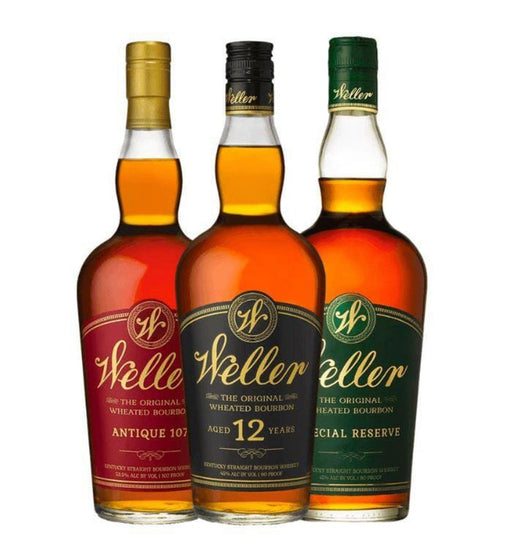
Each W.L. Weller expression carries its own signature bottle, label color, and proof signature on the front label — the Special Reserve is in a forest-green label, the 12 Year carries a black label with a gold age-statement medallion, the Antique 107 carries a red label with the "107" proof prominently displayed, the Single Barrel uses a burnt orange/brown label with the hand-selected single-barrel notation, the C.Y.P.B. carries a white label with the "Craft Your Perfect Bourbon" copy, and the Full Proof carries a blue label with the 114-proof callout. All Weller bottles carry the official Buffalo Trace Distillery production designation (distilled, aged, and bottled at Buffalo Trace Distillery in Frankfort, Kentucky), the William Larue Weller signature script on the front label, and the proof and volume (typically 750 mL). To confirm authenticity on the core lineup, cross-check three points: the expression name and proof on the label must match Buffalo Trace's official current spec for that expression (90, 95, 97, 107, or 114 depending on which Weller you're buying), the label color must match the expression's signature color treatment, and the Buffalo Trace Distillery production designation must appear on the back label. For the William Larue Weller BTAC release specifically, the label does NOT print the vintage year — instead, the bottle proof must be matched against Buffalo Trace's official BTAC spec sheet for that specific release year to identify the vintage (for example, the 2024 release is 125.8 proof and the 2025 release is 129 proof; matching the bottle proof to Buffalo Trace's published annual release spec is the only authoritative way to confirm the vintage of any William Larue Weller bottle). Cana Wine Co. sources every W.L. Weller bottle through licensed Kentucky distribution channels and inspects each one before listing.
How much does W.L. Weller cost, and is it a good investment?
PRICING: Suggested retail across the Weller lineup runs from $25-$30 for the Special Reserve at the entry tier, up through $50-$60 for C.Y.P.B., Single Barrel, and Antique 107, up to $50-$60 for Weller 12 Year, up to $50 for Full Proof, and topping out at $7,500 for the Weller Millennium and ~$120-$140 MSRP for the annual William Larue Weller BTAC release. In practice, every Weller expression sits meaningfully above MSRP on the secondary market — even the entry-level Special Reserve has been pushed into the $60-$80 range on most retail shelves, and the higher-tier expressions (Single Barrel, Full Proof, William Larue Weller) regularly trade at 5-15x their suggested retail.
INVESTMENT: W.L. Weller has been one of the most consistently appreciating bourbon brands in the modern era, anchored by the brand's wheated bourbon heritage, the William Larue Weller BTAC pedigree, the documented Stitzel-Weller historical connection, the brand's modern Buffalo Trace production prestige, and the cultural halo from sister brand Pappy Van Winkle. The William Larue Weller BTAC annual releases are the most aggressively collected Weller expressions and command the strongest secondary-market premiums. Lower-tier expressions (Special Reserve, Antique 107, 12 Year) appreciate more modestly but consistently. Older vintages from the original Stitzel-Weller era (pre-1999) command significant collector premiums for their documented Stitzel-Weller heritage.